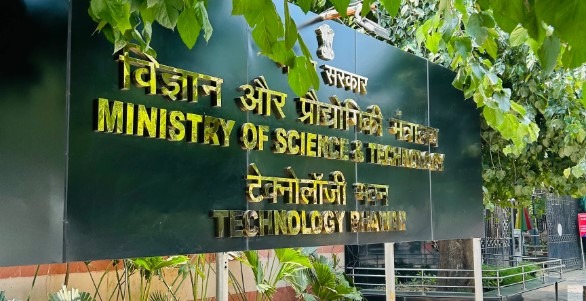
India is among the top-ranking countries in the field of basic research. Indian science
has come to be regarded as “one of the most powerful instruments of growth and
development,” especially in an emerging and competitive economy.
New demands on the science and technology system call for major science projects that
serve national needs and prepare for the technologies of the future. The Department of
Science & Technology (DST) plays a pivotal role in promoting science and technology in
the country, in a wide range of activities, from high-end basic research and cutting-edge
technology development to serving the needs of the common man through skills and
technologies.
Mission and Objectives
DST was established on 3 May 1971, following the success of the Green Revolution, which
showed the innovative use of scientific methods. Over the following forty-three years,
several DST programme streams grew into separate departments or ministries:
1971Department of Science & Technology3 May 1971
DBTDepartment of Biotechnology
DSIRDepartment of Scientific and Industrial Research
MoEFMinistry of Environment & Forests
MNREMinistry of New & Renewable Energy
DoEDepartment of Electronics
MoESMinistry of Earth Sciences
“The DST serves as a nodal agency connecting the science sector to the Government verticals.”
aDeveloping S&T policies.
bStrengthening human resources and institutional capacities.
cEnabling the development and deployment of technologies.
dCreating opportunities for societal interventions through S&T.
eEstablishing and engaging in mechanisms of cooperation, partnerships and alliances.
These approaches aim at a holistic and systemic influence, with immediate, medium- and
long-term relevance, impact across sectors, and synergies that optimise time, human,
institutional and financial resources.
For nearly three decades, DST functioned as an extra-mural research funding agency,
providing competitive research grants to investigators on the basis of technical
merit.
It has since moved towards more proactive and participative functions, and links
policies, plans, programmes and projects to their outcomes through forward and
backward linkages.
Proactively identifying gap areas and creating new programmes and schemes
Evidence-based identification of gaps and needs, balancing competitive and development models
Advocating for larger resource allocations for science
Widening the stakeholder base, with emphasis on stakeholder engagement
Connecting programmes internally and improving planning and coordination of resources
Better understanding of local needs
Balancing equity, expansion and excellence
International S&T cooperation with friendly countries is a national priority, and DST has
been assigned this task. DST works to foster excellence and leadership in research and
development, in line with India's development goals, and to strengthen India's position
nationally, regionally and globally.